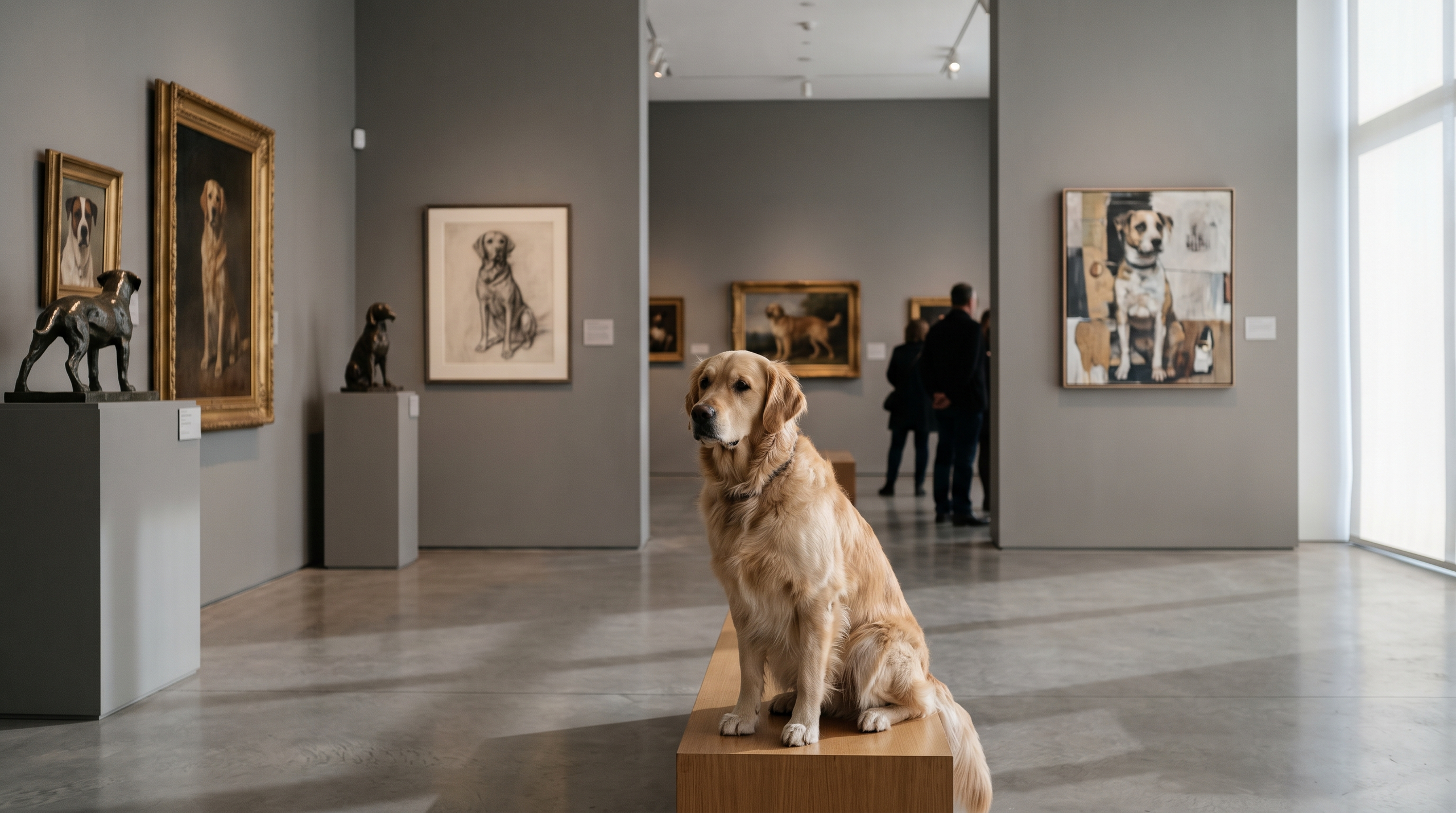

Introduction
Here is the thing about dog photos: the one you love on your phone is almost never the one that makes a great portrait. You have hundreds of pictures of your dog — sleeping, running, mid-bark, that weird angle from above — but only a handful will turn into something you would actually hang. The difference is not the camera. It is knowing which shot works and which style makes your dog look like the painting you did not know you needed.
Dog Art is not about making your pet look like someone else's idea of fancy. It is about turning the photo that feels most like them into something permanent — a portrait that belongs on your wall, not buried in a folder. Whether you want your dog painted in the style of a Dutch master or rendered in soft watercolor, the goal is the same: make it feel like them, and make it worth framing.
The style you choose can make all the difference. Baroque, for instance, is all about drama and warm light, with deep shadows and a glow on the face — it is almost unfair how good this style looks on a dog with soulful eyes. There is also a rich tradition of royal pets in court portraits, the kind you see in museums, full of very serious-looking dogs. Your dog belongs in that company.
If you are considering a portrait because you have lost your pet, I want to acknowledge that a portrait will not fix the loss. But it does keep them in the room, and that can mean more than people expect. For ideas on honoring a pet's memory, you might find Pet Memorial Gifts for Someone Who Lost a Dog or Cat helpful.
By the end of this, you will know which photo of your dog to use, which style suits them, and how to get a portrait that looks expensive — not cheap. No studio required. Just you, your phone, and the shot that actually works.
Understanding Dog Art
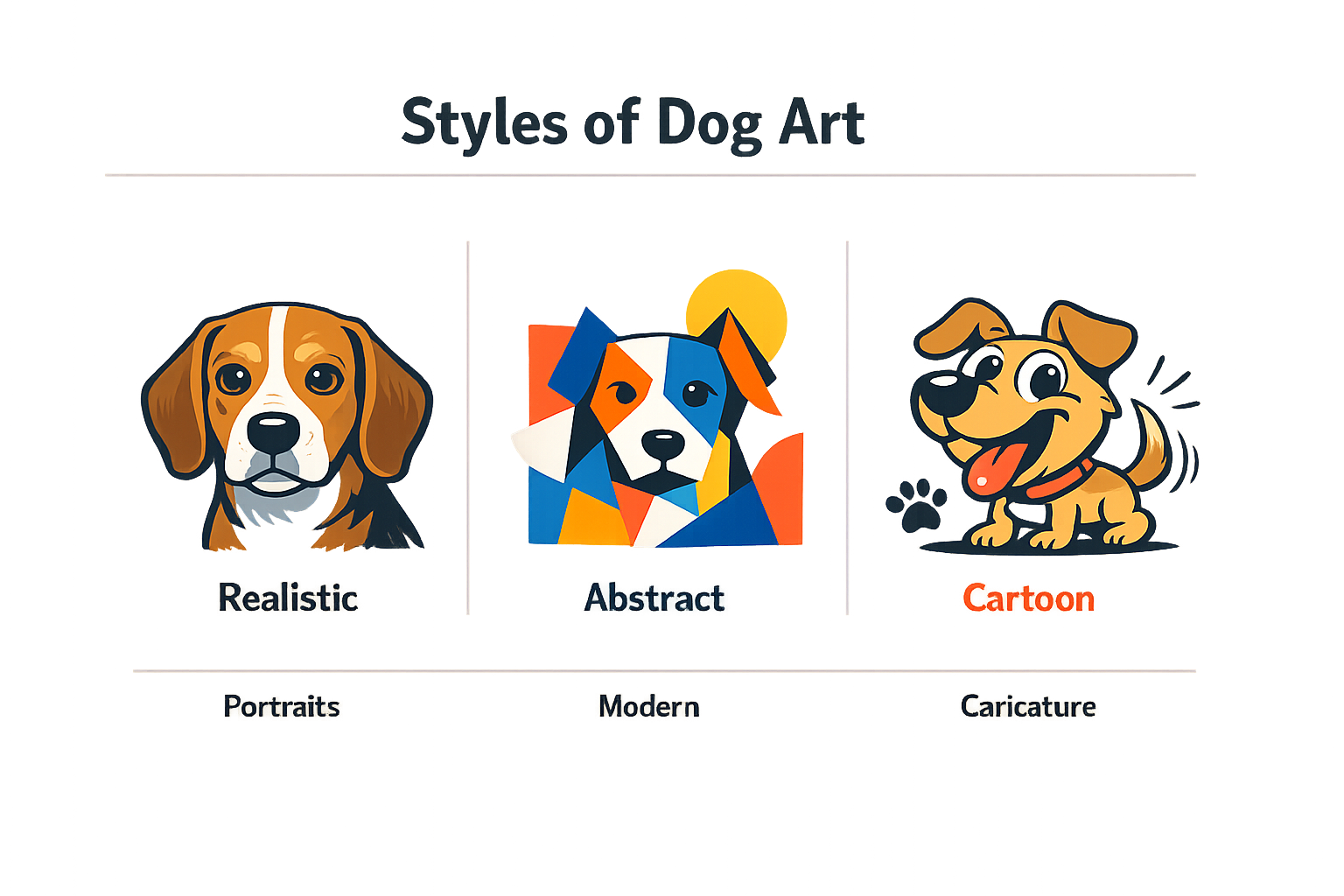
Dog art is any artistic portrait of your dog — painted, drawn, or created digitally — that turns a photo into something worth hanging. It exists as a file before it becomes a print, which means you get to decide how big it goes and where it lives. The whole point is to take the dog you see every day and make them look like they belong in a gallery.
The gap between a snapshot and a portrait is not about fancy equipment. It is about understanding how your dog moves, how light hits their face, and which expression actually looks like them. A good portrait captures the personality — the tilt of the head, the way they hold their ears, the look they give you when they want something.
What Makes Dog Art Different From a Photo
A photo freezes a moment. Dog art interprets it. Whether it is realistic or stylized, the artist (or the tool) makes choices about color, texture, and mood that a camera does not. That is what makes it feel like art instead of documentation.
Realistic dog illustrations gained momentum in the 19th century, when naturalism and scientific illustration took center stage. Artists started paying attention to how dogs actually look — the way muscles shift beneath fur, how light interacts with different coat textures, the small details that make a Labrador look different from a Golden Retriever even when they are sitting the same way.
Popular Styles You Will See
The style you pick changes everything. Renaissance and Baroque lean into drama — warm light, deep shadows, a glow on the face. Royal portraits put your dog in a regal setting, often with rich fabrics and a serious expression. Watercolor feels soft and loose, good for dogs with gentle personalities. Realistic styles focus on getting every detail right, from the texture of the nose to the exact color of the eyes.
If you are looking for something that honors a dog you have lost, pet memorial portraits offer a way to keep them in the room without feeling heavy-handed. The right style makes the portrait feel like them, not like a stranger wearing their collar.
The style you choose can make all the difference — Baroque is all about drama and warm light, with deep shadows and a glow on the face.
Why Dog Art Has Staying Power
People have been painting their dogs for centuries. The Rijksmuseum is full of very serious-looking dogs in court portraits, sitting next to nobility like they own the place. Your dog belongs in that tradition — not because they are royal, but because they matter to you.
Dog art works because it takes something you love and makes it permanent. Photos get lost in your camera roll. A portrait stays on the wall, at their eye level, where you see it every day. That is the part people underestimate — how much it changes the room to have them there.
Choosing the Right Style for Your Dog Art
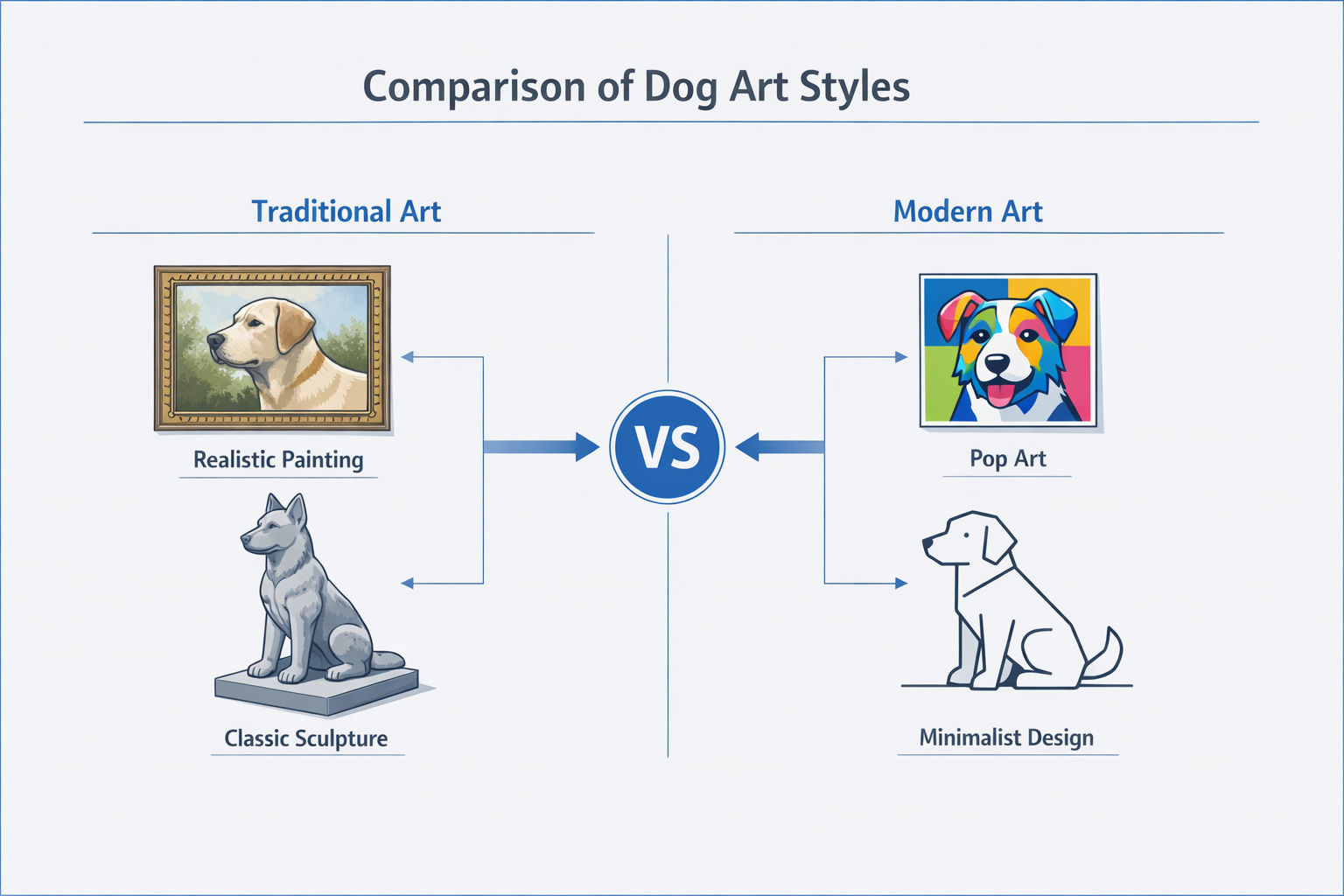
Here is the thing about choosing a style for your dog: the era you choose changes everything. Baroque is all about drama and warm light, with deep shadows and a glow on the face — it is almost unfair how good this style looks on a dog with soulful eyes. Renaissance and royal portraits lean formal and dignified, the kind of thing you see in museums full of very serious-looking dogs. Watercolor feels soft and gentle, good for pets with lighter fur or a sweeter expression. The style is not decoration — it is the whole personality of the portrait.
Match the Style to Your Dog's Personality
A bouncy golden retriever might not suit a dark, moody Baroque treatment. That dog wants light, warmth, maybe something closer to Impressionist brushwork or a bright watercolor. A regal-looking German Shepherd or a stoic bulldog, on the other hand, can absolutely carry a formal royal portrait. Think about the photo you keep coming back to — the one that feels most like them. If it is playful and full of motion, a loose painterly style works. If it is calm and direct, something more structured and classical will feel right.
Your reference photo matters more than you think. A clear, well-lit photo where the eyes are sharp and the fur direction is visible gives any style a better chance. Blurry photos or bad lighting make even the most beautiful style fall flat. Good light does most of the work — natural window light at their eye level is the shot that actually works. If you are not sure which photo to use, choosing the right photo for a pet memorial portrait walks through what to look for.
Traditional vs. Modern Approaches
| Style Type | Best For | What It Feels Like |
|---|---|---|
| Baroque / Renaissance | Dogs with expressive eyes, darker fur, or a calm demeanor | Formal, timeless, museum-worthy |
| Watercolor / Pastel | Light-colored dogs, gentle expressions, softer features | Soft, warm, a little dreamy |
| Royal / Victorian | Breeds with a dignified look, strong posture | Grand, stately, belongs on a gallery wall |
| Impressionist / Painterly | Active dogs, playful expressions, lots of personality | Loose, colorful, full of life |
Modern styles — clean lines, bold colors, graphic treatments — work when you want something that pops on a bright wall. Traditional styles work when you want something that feels like it has always been there. Neither is better. It is about what fits the room and what feels like your dog.
The Little Details That Sell It
Once you have picked a style, the details — collar, background, lighting — need to support it. A royal portrait wants a rich, textured background, maybe a hint of velvet or a dark gradient. A watercolor wants the background to fade and let the dog breathe. Baroque needs contrast, shadow, and a single light source that makes the face glow. These are not optional. They are what make the style work instead of looking like a costume.
The style is not decoration — it is the whole personality of the portrait.
Trust me on this: if you are stuck between two styles, pick the one that matches the light in your photo. A photo with soft, even light will always look better as a watercolor or pastel. A photo with strong directional light — window light from one side, a dramatic shadow — wants Baroque or something classical. Let the photo tell you what it wants to be.
How to Commission Dog Art
Here is the thing about commissioning dog art: the photo you choose does most of the work. If the eyes are sharp and the light is good, the portrait almost paints itself. If the photo is blurry or the dog is half in shadow, even the best artist is guessing at what your dog actually looks like.
Start with the photo. You want one where the eyes are in focus — this is the part people skip, and it is the part that makes or breaks the portrait. The eyes are the most important technical element. When the eyes look correct, the brain accepts the rest of the portrait as plausible. Everything else can be a little soft, but not the eyes.
Step 1: Pick the Right Photo
Step 1
Find the shot that actually works
Go through your phone and look for a photo where the eyes are sharp, the fur direction is visible, and the light is soft and even. No harsh shadows across the face. No weird cropping where half the ear is missing. The photo does not have to be perfect, but it does need to show what your dog really looks like.
Good light does most of the work here. Natural light from a window or outdoors in the morning or late afternoon is your friend. Overhead indoor lights flatten everything and make the fur look muddy. If you are choosing between a technically perfect photo where your dog looks like a stranger and a slightly imperfect one where you can see her personality, pick the second one.
Step 2: Describe Your Dog's Personality
Step 2
Give the artist two or three plain words
Write down how your dog actually is — not how you wish she looked or how she acts in the perfect moment, but her real baseline. Sweet and anxious. Confident and slightly imperious. Goofy and always moving. The artist needs this to get the expression right, and it only takes a sentence.
This is where people overthink it. You are not writing a novel. Just tell the artist the tone you want them to capture. If your dog has a signature look — ears always back, tongue always out, one eyebrow permanently raised — mention it. Those little details that sell it are what make the portrait feel like them.
Step 3: Choose Your Style
You already know the major styles — Renaissance, royal, watercolor, contemporary. Pick the one that matches the vibe of the photo and the dog. A serious, dignified dog with a calm expression works beautifully in a royal or Baroque style. A playful, soft-faced dog might be better in watercolor or a lighter, more impressionistic approach.
If you are not sure, trust your gut. The style you keep coming back to when you look at examples is probably the right one. For more guidance on matching styles to your dog's personality, check out Custom Dog Paintings From Your Photo: Styles, Process & Pricing.
Step 4: Review the Details Before Finalizing
Step 3
Double-check proportions and expression
Before the artist finalizes the portrait, look at the eyes first, then the overall proportions. Are the eyes too small? Is the head shape right? Does the expression match what you described? If something feels off, say it now — it is much easier to adjust at this stage than after the portrait is finished.
Common mistakes to watch for: eyes that are too small or too far apart, ears that are the wrong shape or angle, and fur that all goes in one direction when your dog's coat has natural variation. These are small things, but they are the difference between a portrait that looks like your dog and one that looks like a dog.
Step 5: Let the Portrait Breathe
Once the portrait is done, give it space. Do not crowd it with other frames or hang it somewhere it competes for attention. A portrait worth framing deserves a spot where people can actually see it. At their eye level, with a little breathing room on all sides.
If this is a memorial portrait, take your time with placement. You will know where it belongs when you see it. There is no rush.
Benefits of Dog Art
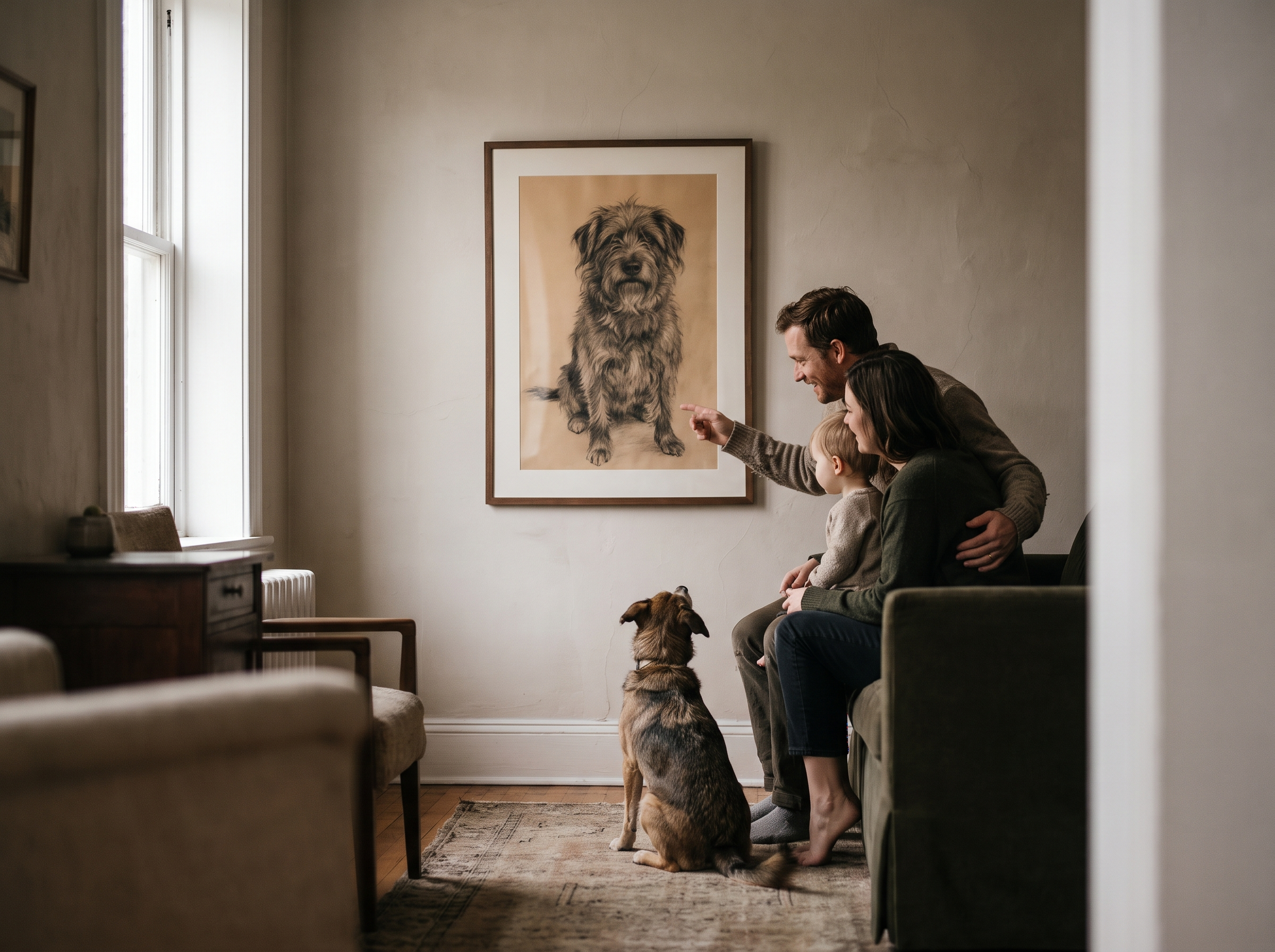
Here is the thing about dog art: it does more than fill a blank wall. A portrait of your dog keeps them in the room with you, and that matters more than people expect. Whether your dog is still bounding around the house or you are holding onto their memory, a portrait worth framing gives you something to look at that feels like them — not just a photo on your phone you scroll past.
The emotional pull is real. You see their face every day, painted in a way that captures their personality, and it changes how the room feels. It is not sentimental fluff — it is the comfort of having them present, even when they are not.
Dog Art as a Daily Reminder
A portrait on your wall does quiet work. You walk past it in the morning, you catch it out of the corner of your eye at dinner, and it reminds you why you love this animal so much. The little details that sell it — the tilt of their head, the look in their eyes — bring back the moments you want to keep.
This is especially true if you have lost your pet. A portrait does not fix the loss, but it does keep them in the room. That presence can mean more than you think when the house feels too quiet.
A portrait worth framing gives you something to look at that feels like them — not just a photo on your phone you scroll past.
Sharing and Celebrating Your Dog
Dog art is also wildly shareable. People love showing off their pets, and a well-done portrait taps into that pride. You post it, your friends comment, and suddenly everyone is talking about their own dogs. It is a conversation starter that never gets old.
Beyond social media, dog art makes a gift that actually lands. If someone you know has lost a dog, a memorial portrait can be one of the most thoughtful things you can give them. It acknowledges the loss without being heavy-handed, and it gives them something beautiful to hold onto.
Practical Benefits You Don't Expect
There are practical upsides too. A custom portrait fills wall space in a way that feels personal and intentional, not like you grabbed something generic from a home goods store. It anchors a room, especially if you choose a style that matches your decor — whether that is a dramatic Baroque piece or a softer watercolor.
And if you ever move, dog art travels well. It is yours, it is meaningful, and it works in any space where you want a reminder of your best friend.
Caring for Your Dog Art
You spent time choosing the photo, picking the style, and getting the portrait just right. Now you need to keep it looking good. Here is the thing: a portrait worth hanging is a portrait worth protecting.
Where to Hang It
Light does most of the work when you are taking a photo, but it can ruin a finished portrait if you are not careful. Direct sunlight fades prints and canvases over time — the colors lose their punch, and the whole thing starts looking washed out. Hang your dog art somewhere with soft, indirect light. A wall that gets morning sun through sheer curtains is fine. A wall that bakes in afternoon sun all summer is not.
Keep the portrait at their eye level — or yours, if you want to look at it without craning your neck. Let the photo breathe. Give it space on the wall so it is not crowded by other frames or furniture. A single portrait on a clean wall reads as intentional. Three portraits crammed together with a lamp in front reads as clutter.
Cleaning and Maintenance
Dust happens. Use a soft, dry microfiber cloth and wipe gently. Do not spray anything directly on the surface — if you need to clean a smudge, lightly dampen the cloth with water and test a corner first. For framed prints behind glass, standard glass cleaner on the glass is fine, but keep it off the frame.
If your portrait is on canvas, avoid touching the surface with your fingers. Oils from your skin can leave marks that are hard to remove. If the canvas gets a dent or a crease, do not try to fix it yourself — a professional framer can usually repair it without making it worse.
Framing and Protective Measures
A good frame does more than look nice — it protects the edges and keeps the portrait flat. If your dog art came unframed, get it framed before you hang it. A simple frame in a neutral color works for almost any style. If you went with a royal or Renaissance portrait, a slightly ornate frame in gold or dark wood can sell the era you chose.
For prints, use UV-protective glass or acrylic if you can. It costs a little more, but it blocks the light that causes fading. For canvas, a light coat of UV-protective varnish (applied by a professional) can do the same thing. Do not skip this step if the portrait is going anywhere near a window.
Avoid hanging dog art in bathrooms, kitchens, or anywhere with high humidity or temperature swings. Moisture warps canvas, yellows paper, and loosens adhesive. The little details that sell a portrait — the texture, the color depth, the crispness — are the first things to go when the environment is wrong.
Long-Term Storage
If you need to store a portrait, keep it flat in a cool, dry place. Wrap it in acid-free tissue paper or glassine, not plastic. Plastic traps moisture. Stack prints with a piece of cardboard between each one so they do not stick together. For rolled canvases, roll them with the painted side facing out and store them in a tube — never fold or crease them.
Check on stored portraits once a year. Look for discoloration, mold, or insect damage. If you catch a problem early, it is usually fixable. If you wait until the portrait is ruined, it is not.
Your dog deserves a portrait that lasts as long as the memory does. Treat it like the piece of art it is, and it will keep them in the room for years.
Conclusion
Here is the thing about dog art: the photo you love on your phone is almost never the one that makes a great portrait. But now you know what to look for — good light, a clear expression, and a shot where your dog actually looks like themselves. The style you choose matters too. Baroque is all about drama and warm light, with deep shadows and a glow on the face. It is almost unfair how good this style looks on a dog with soulful eyes. There is also a rich tradition of royal pets in court portraits — your dog belongs in that company.
Whether you are celebrating a birthday, honoring a memory, or just want something worth hanging, dog art keeps them in the room. It does not have to be perfect to work. The portrait you keep coming back to is the one that feels like them — soft, warm, and a little dramatic. Trust me on this: you will know it when you see it.
If you are considering a portrait because you have lost your pet, I want to acknowledge that a portrait will not fix the loss. But it does keep them in the room, and that can mean more than people expect. A pet memorial portrait is a way to honor their memory and keep their presence alive in your home.
Start with the photo that makes you smile. Pick a style that suits their personality. Let the photo breathe, frame it well, and you will have something you actually want to look at every day. That is the whole game.
Discover how to turn your beloved dog into a stunning work of art. Explore various styles and techniques to celebrate your furry friend.