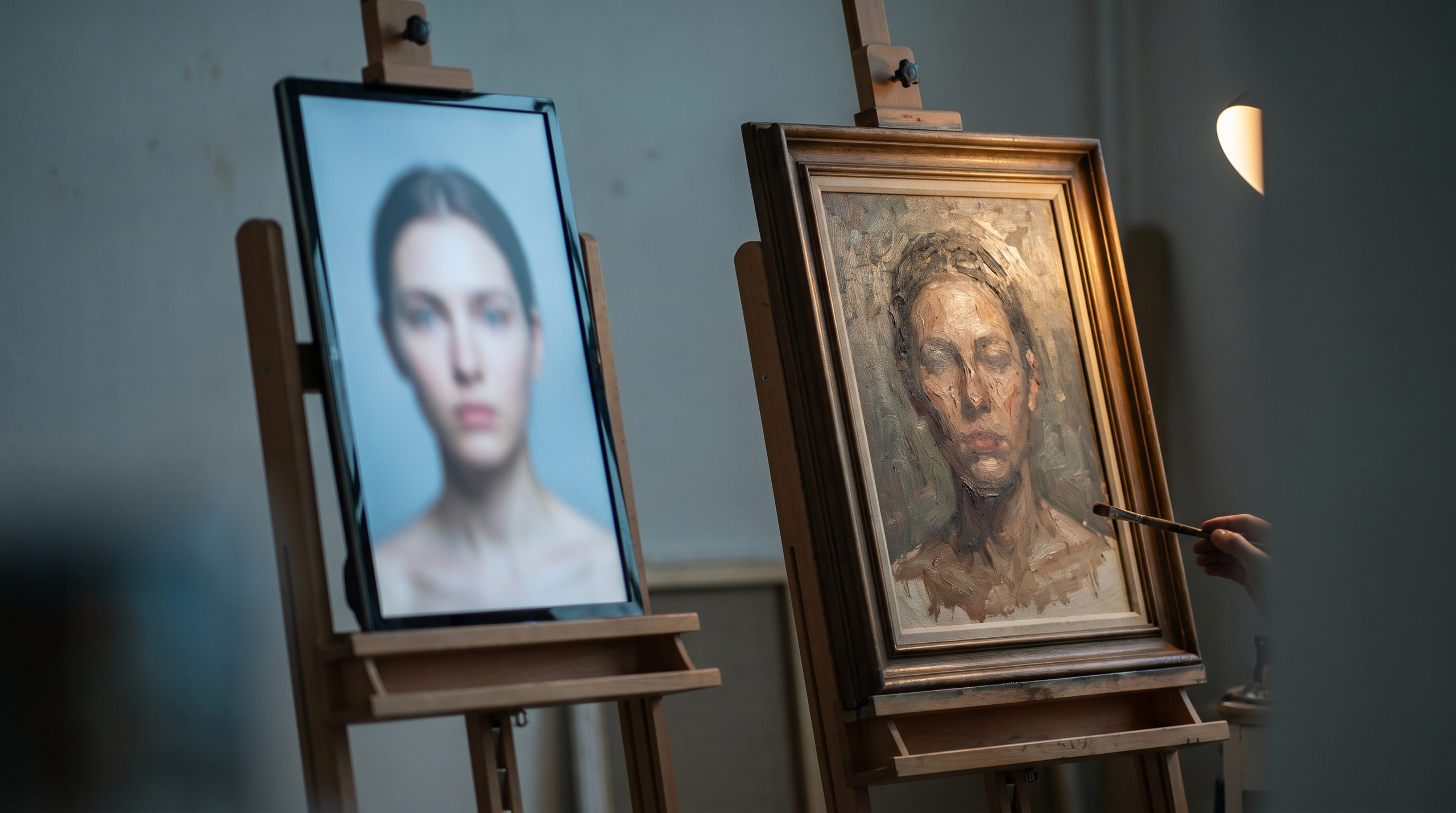
AI Portrait vs Hand-Painted Portrait: Introduction
AI Portrait vs Hand-Painted Portrait is a choice many face when selecting a portrait style. An AI portrait starts with a photo you upload. Software analyzes it, applies artistic filters or generative techniques, and produces a digital file that mimics painting styles — Renaissance, watercolor, oil, whatever the algorithm was trained on. You get a result in minutes or hours, and it costs a fraction of what a human artist charges.
A hand-painted portrait is made by a person with a brush. They study your photo, mix paint, and build the image layer by layer on canvas or paper. It takes days or weeks. It costs more. And it gives you something physical — texture, brushstrokes, the tiny imperfections that come from a human hand. If you appreciate fine art as a physical medium, the tactile experience of real oil or acrylic on canvas matters.
Here is the thing about choosing between an AI portrait and a hand-painted one: the question is not which is better — it is which one gives you what you actually want. I have spent years looking at portraits people love and portraits people regret, and the difference almost always comes down to knowing what you are buying before you buy it. The output is consistent, repeatable, and often surprisingly good at capturing likeness.
Neither option is a compromise. They are different tools for different jobs. If you want a portrait that feels like them — your dog, your kid, your late grandmother — both can deliver. The question is whether you care more about speed and price, or about owning an original piece of art you can run your fingers over. By the end of this you will know exactly which route makes sense for you.
For a deeper dive into how different artistic styles work for pet portraits specifically, see Dog Painting Styles: Watercolor vs Oil vs Renaissance.
Quality Comparison
Here is the thing about quality: it depends entirely on what you are trying to hang on your wall. An AI portrait nails the exact likeness — every whisker, every eye color, every marking — because it is working directly from your photo. A hand-painted portrait gives you interpretation, expression, and the visible brushwork that makes it feel like art you would find in a gallery. Neither is better across the board; they are solving different problems.
What AI Does Well (and Where It Falls Short)
AI wins on exact likeness, consistency, and speed. You upload a photo, choose a style, and you get a portrait that looks like your pet or your person — no guesswork, no back-and-forth revisions. The colors match, the proportions are accurate, and if you order three different styles, they will all capture the same subject faithfully. That consistency is why AI portraits work so well for gifts: you know what you are getting before you commit.
The trade-off is that AI portraits can feel a little flat when you see them in person. A wedding portrait can look perfect on screen and still fall flat as wall art — the brushwork is simulated, not real, and the texture does not catch the light the way paint does. If you are framing it behind glass, that difference shrinks. If you are putting it on canvas and expecting it to hold a room, you will notice.
What Hand-Painted Work Brings (and What It Costs You)
Hand-painted portraits give you interpretation, expression, and the ability to revise toward what you want. An artist can soften a harsh shadow, adjust a background, or emphasize the warmth in your dog's eyes in ways that feel intentional rather than algorithmic. You are paying for their eye, their process, and the visible evidence that a human made this thing for you. That is what makes hand-painted work feel expensive — because it is.
The downside is unpredictability. You are trusting someone else's interpretation of your photo, and if their style does not align with what you had in your head, you are stuck negotiating revisions or walking away. Hand work also takes weeks, sometimes months, and the cost reflects that time investment. If you need something fast or you are working within a tight budget, hand-painted is probably not the move.
| Quality Factor | AI Portrait | Hand-Painted Portrait |
|---|---|---|
| Likeness accuracy | Exact match to photo | Interpreted; may vary |
| Texture and brushwork | Simulated | Real paint, visible strokes |
| Revision flexibility | Limited to style choice | Artist can adjust details |
| Consistency across orders | High | Varies by artist |
| Wall presence (framed) | Good on screen, can feel flat in person | Strong, catches light naturally |
The Part People Skip: What Looks Good Where
If you are hanging a portrait in a hallway or a bedroom where people see it up close, hand-painted work holds up better — the texture and the visible process give it depth. If you are putting it on a gallery wall with other prints, or if it is going behind glass in a frame, AI portraits work beautifully and no one will know the difference unless they are standing six inches away.
The other thing to consider is the era you choose. Dog painting styles like watercolor, oil, and Renaissance each bring their own texture and formality — some styles mask the difference between AI and hand work better than others. A loose watercolor or a dramatic Renaissance portrait hides the seams; a tight, photorealistic oil painting makes the lack of real brushwork more obvious.
AI wins on exact likeness, price, speed, and consistency. Hand work wins on interpretation, expression, the visible process, and the ability to revise toward what you want. Neither is wrong — it is about matching the method to the wall and the moment.
Cost Analysis
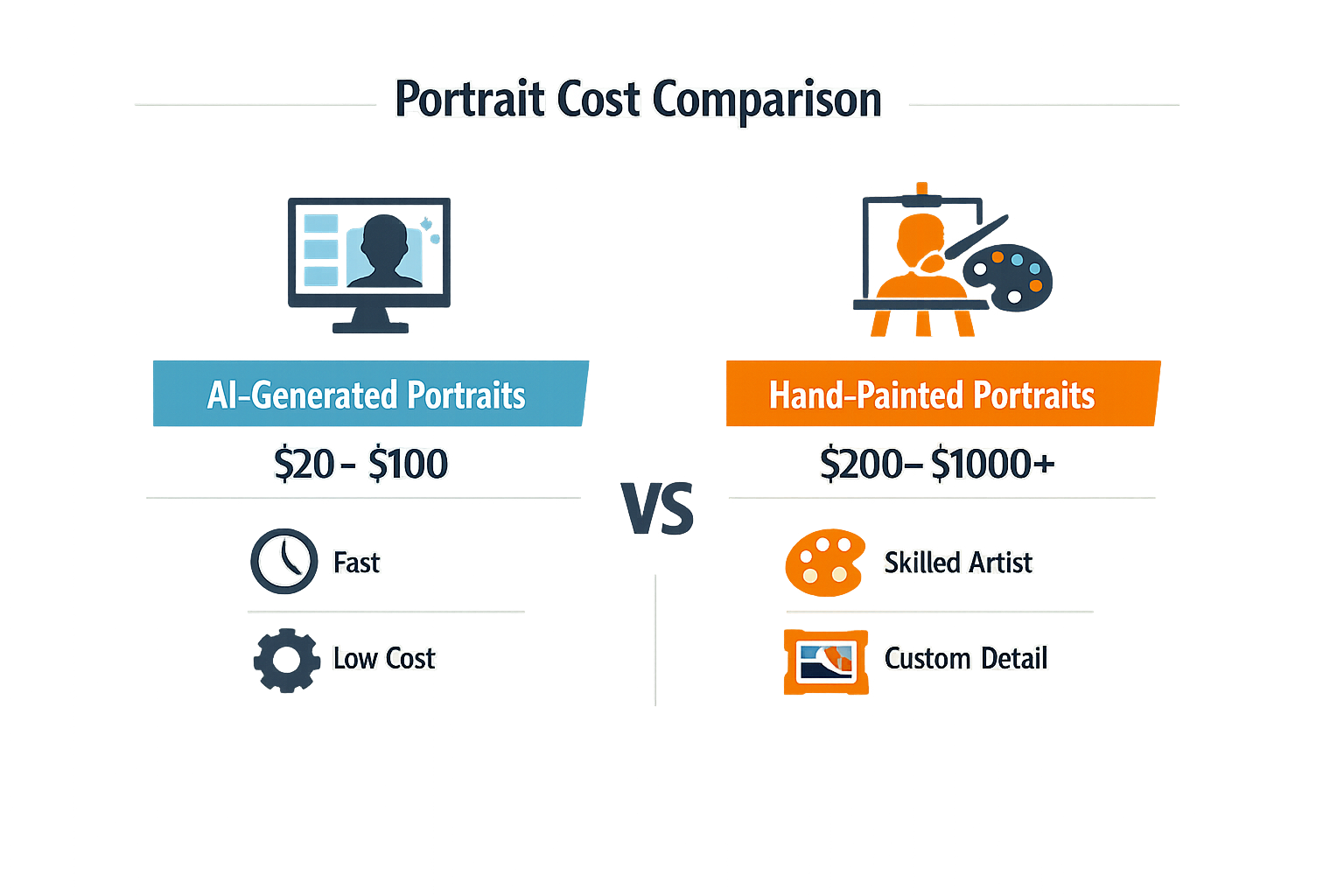
Here is the thing about cost: it is the first question everyone asks, and for good reason. A hand-painted portrait and an AI portrait sit in completely different price brackets — not just a little different, but different enough that it changes who can afford what.
Hand-painted portraits start around a few hundred dollars for a small piece from an emerging artist and climb fast from there. A custom oil painting of your dog from a working professional typically runs $500 to $2,000 depending on size, detail, and the artist's reputation. If you want a large canvas or a well-known painter, you are looking at $3,000 and up. The price reflects hours of labor — sketching, blocking in color, layering, drying time, revisions. You are paying for skill, materials, and the artist's time, which is finite.
AI portraits, by contrast, are a fraction of that. Most services charge between $20 and $100 for a digital file or a printed canvas. You upload a photo, choose a style, and the system generates the portrait in minutes. The cost is low because the labor is automated — no brushes, no drying time, no back-and-forth with a human painter. You get the file fast, and if you want it printed, that is usually an add-on.
| Portrait Type | Typical Cost Range | What You Get |
|---|---|---|
| Hand-Painted | $500–$2,000+ | Custom oil or acrylic on canvas, original artwork, artist revisions |
| AI Portrait | $20–$100 | Digital file or printed canvas, instant generation, style presets |
What Drives the Price Difference
The gap comes down to labor and scarcity. A painter can only finish so many portraits a year. Each one takes days or weeks. An AI system can generate hundreds in an afternoon. That changes the economics entirely.
With a hand-painted piece, you are also paying for the original. You own the only version of that painting. It is a one-of-one object. With AI, the output is digital-first — reproducible, scalable, and not unique in the same way. That does not make it worthless, but it does change what you are buying.
If budget is tight, AI is the obvious path. If you want something that feels like an heirloom — something you can pass down — hand-painted is worth the investment. Both have their place. The question is what you value more: affordability and speed, or originality and the human touch.
For more on transforming your pet photos into dog canvas prints, we have a full guide on turning everyday snapshots into gallery-ready art.
Time Taken for Creation
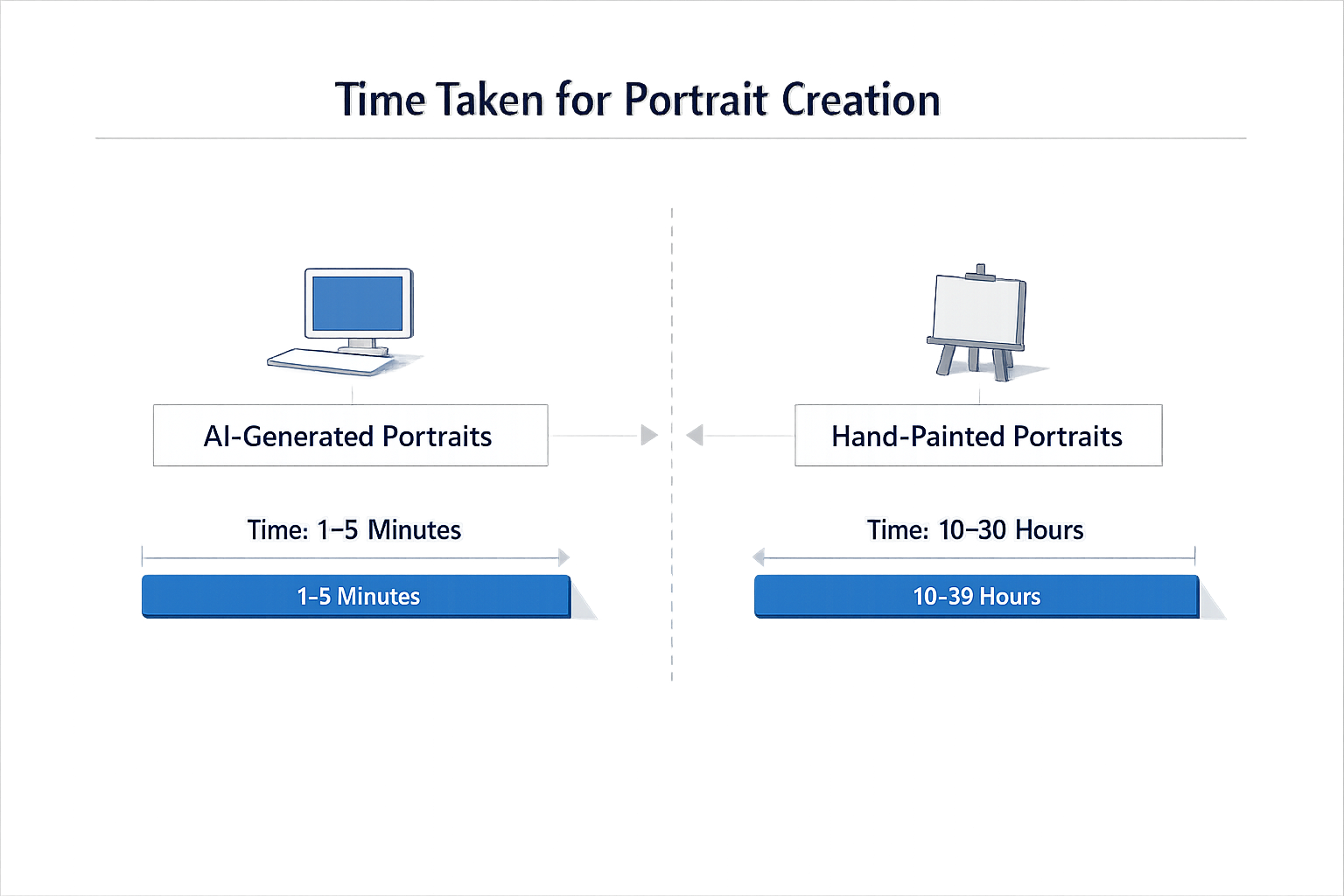
Here is the thing about time: it is the one part of this comparison where there is no contest. AI portraits happen in seconds. Hand-painted portraits happen in weeks — sometimes months if the artist has a waitlist.
If you need a portrait tomorrow for a birthday or a memorial service, AI is your only real option. If you have time to wait and want the slow, deliberate process of commissioning custom art, hand-painted is worth the calendar space it takes up.
How Fast AI Portraits Actually Are
AI portrait generators can create professional-quality portraits in seconds rather than hours. You upload a photo, pick a style, and the portrait renders while you are still looking at the screen. Most tools give you the final file in under a minute.
That speed is not just convenient — it changes what you can do with portraits. You can try three different eras, compare them side by side, and still have your final choice framed before dinner. No back-and-forth emails. No waiting to see if the artist interpreted your notes correctly.
The Hand-Painted Timeline
A custom hand-painted portrait typically takes two to six weeks, depending on the artist's schedule and the complexity of the piece. That includes time for the artist to review your photo, do preliminary sketches, paint the portrait in layers, let it dry, and ship it to you.
If the artist is in demand, add another few weeks — or months — just to get on the calendar. Holiday seasons and memorial requests can push timelines even further.
The wait is part of the process. You are not just buying a product; you are waiting for someone to sit down, focus on your pet or your person, and build something by hand. That takes the time it takes, and rushing it usually shows in the final piece.
When Time Matters Most
If you are working on a memorial gift or a surprise birthday portrait, the calendar is not flexible. AI portraits let you work backward from the date and still get something worth hanging. You can order, approve, print, and frame in the same week if you need to.
For anniversaries, holiday gifts, or just because — when the date is not set in stone — hand-painted portraits give you the luxury of time. You can collaborate with the artist, request changes, and let the piece evolve. That process has value, but only if you have the weeks to let it happen.
The fastest portrait is not always the right portrait, but the slowest one is not always better either — it depends on what you need and when you need it.
Time is not a quality issue. It is a logistics issue. Both options can give you something beautiful. One just does it before lunch, and the other does it before the season changes. If you are weighing these two paths, check out how to choose the right photo for a pet memorial portrait — the photo you start with matters more than the method you use to turn it into art.
User Experiences and Testimonials
Here is the thing about choosing between AI and hand-painted portraits: the people who have done it already have strong opinions. Not because one is objectively better — but because what matters to you shapes which trade-offs you are willing to make. Some people want the photo nailed exactly as it was. Others want the artist to see something in the photo that they did not.
What AI Portrait Users Say
People who go with AI portraits tend to love three things: the speed, the price, and the fact that the likeness is locked in. You upload the photo, you get back a portrait that looks like your dog — not someone else's interpretation of your dog. That consistency matters when you are working from a specific memory or a favorite shot. One user put it this way: AI wins on exact likeness, price, speed, and consistency. If you need it to look like the photo, AI delivers that without asking you to trust a stranger's eye.
The trade-off? You do not get to revise it toward what you want. The output is what it is. If the AI reads the lighting one way and you wish it had read it another, you are starting over with a new photo. There is no back-and-forth, no sketch round, no "can we soften the expression a little?" You get precision, but not interpretation.
What Hand-Painted Portrait Users Say
People who commission hand-painted portraits talk about the process differently. They are paying for someone to see the photo the way they see it — or the way they wish they could. Hand work wins on interpretation, expression, the visible process, and the ability to revise toward what you want. You get a sketch. You give feedback. The artist adjusts. By the time it is done, it feels like a collaboration, not a transaction.
That process takes longer and costs more, but for a lot of people it is worth it. They want the brushstrokes. They want the artist to make a choice about the light or the background or the way the ears sit. They want it to feel like someone made this, not like it came out of a machine. If you are turning a memorial photo into something you will hang for the next twenty years, that human touch can matter more than speed.
The Hybrid Approach
Some people use both. They run the photo through an AI preview to see which style works — Renaissance, watercolor, oil — and then take that direction to a traditional artist who paints it by hand. You get the speed and clarity of AI as a proof-of-concept, and then the depth and revision process of hand work for the final piece. It is not the cheapest route, but it is the one that gives you the most control over the outcome.
The people who regret their choice — on either side — are usually the ones who did not know what they were trading off. If you went with AI expecting brushstrokes and revision rounds, you are going to be disappointed. If you went with hand-painted expecting it in three days, same problem. Know what you are buying, and the outcome almost always lands where you want it.
Conclusion: Which is Right for You?
Here is the thing: both options work. The question is which one fits what you actually need — not what sounds better on paper.
AI wins on exact likeness, price, speed, and consistency. If you want a portrait that looks exactly like the photo you uploaded, costs less than dinner for two, and arrives in days instead of weeks, AI is your answer. It does not interpret or improvise — it delivers what you gave it, painted in the style you picked. For gifts, memorials, or filling a gallery wall without the wait, that precision matters.
Hand-painted work wins on interpretation, expression, the visible process, and the ability to revise toward what you want. A real artist sees past the pixels — they notice the tilt of an ear, the weight in an expression, the thing that makes your dog your dog. They can adjust as they go, soften a background, shift a pose slightly, bring warmth to a face that the camera flattened. If you want something that feels like a collaboration, or if the act of commissioning art is part of the gift, hand-painted is worth the time and cost.
Who Should Choose What
Pick AI if you need multiple portraits, a tight budget, or a fast turnaround. Pick AI if you love the photo exactly as it is and want it translated into paint without editorial input. Pick AI for consistency across a series — matching frames, matching styles, no variation between pieces.
Pick hand-painted if you want a single heirloom piece, if the subject is tricky (bad lighting, motion blur, a face half-hidden), or if you want the artist to interpret rather than replicate. Pick hand-painted if the process itself — the back-and-forth, the progress photos, the knowledge that a real person spent hours on this — adds meaning to the finished work.
Trust me on this: the best portrait is the one you will actually hang. If speed and price let you finally get that photo off your phone and onto the wall, AI wins. If waiting two months and spending more means you get a piece you stare at every morning, hand-painted wins. Neither choice is wrong — they just solve different problems.
For more ideas on turning your favorite photos into gallery-ready art, explore styles that fit your space and budget. If you want to see how royal dog portraits capture your pet's personality in regal styles, or browse thoughtful memorial gifts for someone who has lost a companion, we have guides to help you find the right approach. The right portrait is the one that keeps them in the room with you.
Frequently asked questions
Can AI portraits match the quality of hand-painted work?
AI portraits excel at exact likeness and consistency but lack the physical texture and brushwork of hand-painted art. They work well behind glass or on gallery walls where the simulated brushwork is less noticeable. Hand-painted portraits offer real depth, visible strokes, and the ability to interpret emotion in ways algorithms cannot replicate.
How much does an AI portrait cost compared to hand-painted?
AI portraits typically cost $20 to $100 for a digital file or printed canvas. Hand-painted custom portraits range from $500 to $2,000 for professional work, with larger or more detailed pieces reaching $3,000 and up. The price difference reflects labor time, materials, and the uniqueness of an original painting.
How long does it take to create each type of portrait?
AI portraits generate in seconds to minutes. Hand-painted portraits take two to six weeks on average, depending on the artist's schedule and the complexity of the piece. If the artist has a waitlist or the request is during a busy season, hand-painted timelines can extend to several months.
Which portrait type is better for memorial gifts?
Both work for memorials, but the choice depends on your timeline and what feels meaningful. AI portraits deliver quickly when time is short and offer exact likeness. Hand-painted portraits provide a tangible, one-of-a-kind piece with visible human effort, which many find comforting for long-term display.