
Introduction
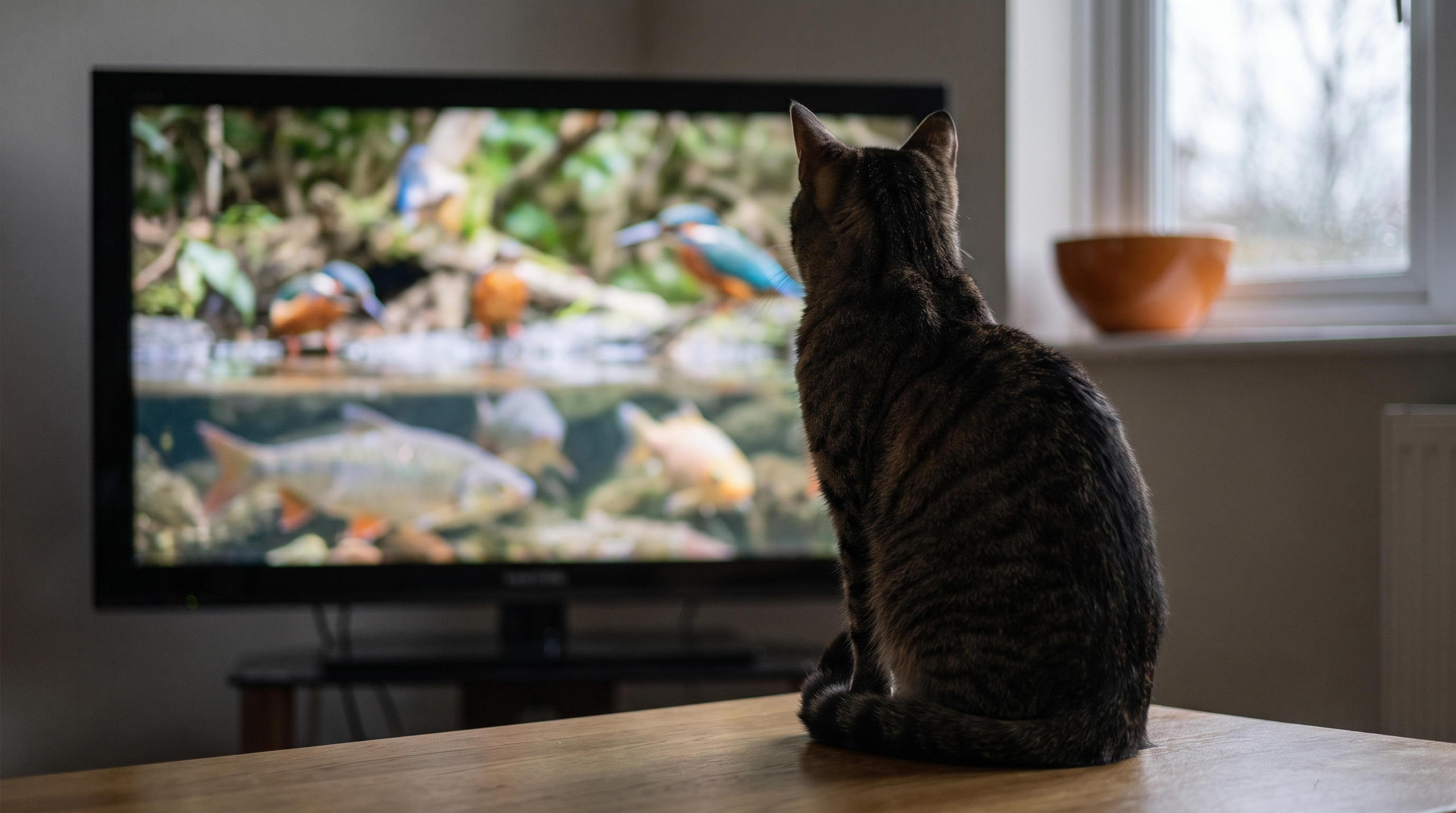
Can cats watch TV? Yes. Cats can see movement on screens, and some will stare at videos designed for them with the same intensity they bring to hunting. The difference between a cat who watches and one who ignores the screen is not whether cats can watch TV — it is whether what is on the screen looks like something worth their attention.
Cats are obligate carnivores, which means their eyes evolved to detect movement — specifically, the kind of movement that signals prey. A bird flitting across a branch, a mouse darting through grass, a fish flickering near the surface. When a screen shows that kind of motion, your cat notices. When it shows two people talking in an office, your cat does not care.
Cat TV is built around this. It presents visuals that resemble prey — birds, squirrels, fish — and it works because it taps into the same tracking abilities your cat uses when she is hunting. For indoor cats especially, this can provide mental stimulation and a way to engage instincts that do not get much of a workout otherwise. If you have ever wondered whether custom cat portraits capture that same intensity, the answer is yes — but only if the photo you start with shows her at her sharpest.
Not every cat will respond the same way. Some will watch for a few seconds and lose interest. Others will sit in front of the screen for minutes at a time, paw at it, or chirp at the birds. The question is not whether your cat should watch TV — it is whether the screen offers something that looks, moves, and sounds like the real thing to her.
By the end of this you will know how cats perceive screens, what visuals grab their attention, and whether your cat is likely to enjoy it. Let me show you why some cats are glued to the screen and others could not care less.
Understanding Cat Vision
Here is the thing about cats and screens: what you see on TV is not what your cat sees. Their eyes work differently — not worse, just built for a different job. Where you notice color and detail, your cat notices movement and contrast. That gap explains a lot about why some cats stare at the screen and others could not care less.
Cats are dichromatic, meaning they see shades of blue, green, and yellow, but perceive reds and pinks as grays. The bright red cardinal you are watching in a nature documentary? Your cat sees it as a moving gray shape against green leaves. The color palette on your screen is muted for them — less saturated, less varied, but still perfectly readable in the ways that matter to a predator.
What Cats See When They Look at a Screen
Their eyes are more sensitive to movement than ours. A bird flitting across the screen registers instantly, even if the image is blurry or low-contrast to us. That is the part of their vision that evolved to track prey in low light, and it works just as well on a flat panel as it does in a dim hallway. TV images appear differently to them — not sharper or clearer, but more responsive to motion cues.
This sensitivity to movement is why a slow, panning nature shot might bore your cat, but a quick cut to a darting mouse gets an instant head tilt. They are not watching the story — they are tracking the motion. When you are choosing a photo for a custom cat portrait, the same principle applies: the shot where they are alert and focused, eyes locked on something, is the one that feels alive.
What you see on TV is not what your cat sees — their eyes are built to track movement, not admire the color grading.
The takeaway: cats can watch TV, but they are watching a different version of it. Blues and yellows pop. Reds disappear. Movement is everything. If the screen is static, they lose interest fast. If something is darting around, they are locked in.
What Cats Respond to on Screen
Here is the thing about what grabs your cat's attention on TV: it is almost always about movement. Not just any movement — the kind that mimics prey. Birds hopping across a branch, fish darting in water, small animals scurrying through grass. That is what stops them mid-groom and gets them staring at the screen.
Cats process motion differently than we do. They can pick up 70 to 80 frames per second, while humans max out around 30 to 50. That means they see individual frames where we see smooth motion. Fast-moving objects on screen — especially ones that change direction suddenly — register as real to them in a way that slow pans or static shots do not.
The Visuals That Work
The images that hold a cat's attention are the ones that look like something they would hunt. Birds are at the top of the list. Fish come in a close second. Anything small, quick, and unpredictable triggers that instinct to track and pounce. Nature documentaries, bird-feeder cams, and videos designed specifically for cats lean into this — lots of erratic movement, high contrast, and objects that move in and out of frame.
Still images or slow-moving content? They lose interest fast. Your cat is not sitting down to watch a drama unfold. They want action, and they want it now.
Sound Matters Too
Movement is the main driver, but sound plays a supporting role. High-pitched chirps, rustling leaves, the flutter of wings — these audio cues can pull a cat's attention to the screen even if they are across the room. The sound does not have to be loud; it just has to hit the right frequency range that signals prey or something worth investigating.
That said, not every cat reacts the same way. Some will perk up at bird calls and ignore everything else. Others might track a laser pointer on screen but walk away from the same bird video that had their sibling glued to the TV. The common thread is movement that mimics natural prey patterns — that is what cuts through the noise.
If you are thinking about turning a favorite moment of your cat into something worth hanging, custom cat portraits let you capture their personality in a way a screenshot never will. The photo you love on your phone is almost never the one that makes a great portrait — but that is a conversation for another time.
Can Cats Watch TV and Actually Enjoy It?
Here is the thing: not every cat cares about the screen. Some will sit there, locked in, chattering at birds like they are about to pounce through the glass. Others will glance over, shrug, and go back to their nap. It depends on the cat — and what is moving on screen.
When cats do watch, it is because their hunting instincts kick in. They see something dart across the frame — a bird, a mouse, a fluttering leaf — and their brain says prey. You will see the signs: tail swishing, ears forward, maybe a crouch or that weird chattering sound they make when they spot something they want to catch. That is engagement, and it is real.
What Happens When They Realize It Is Not Real
The problem is, most cats figure it out pretty fast. They watch the movement, get excited, maybe even swat at the screen — and then nothing happens. No catch, no chase, no reward. Once they realize the images are not real, they lose interest. The screen becomes background noise.
For some cats, that realization is frustrating. If they cannot physically catch what they see, it can cause anxiety instead of entertainment. You might notice pacing, restlessness, or even aggression toward the screen. That is the cat equivalent of wanting something they cannot have — and it does not feel good.
The Cats Who Actually Enjoy It
Then there are the cats who seem genuinely entertained. They watch calmly, track movement without the frustration, and treat it like a low-stakes game. These are usually cats who are bored, indoor-only, or naturally curious. For them, TV is mental stimulation — something to look at when there is not much else happening.
The key difference is temperament. A confident, playful cat might enjoy the visual variety. A more anxious or high-strung cat might find it stressful. You will know which camp your cat falls into by watching how they act after the screen goes off. Relaxed? Great. Pacing and yowling? Maybe skip the bird videos.
Cats react to moving images on TV because it triggers their instinct to hunt — but when they realize the images are not real, they often lose interest.
If you are thinking about turning a favorite photo of your cat into something worth hanging — not a screenshot, but a real portrait — check out custom cat portraits. It is a way to celebrate them that does not depend on whether they care about screens.
Tips for Cat Owners
If your cat shows interest in the screen, here is how to make it work without turning your living room into a cat-versus-TV wrestling match.
Keep Sessions Short
Limit screen time to 10 to 30 minutes, once or twice a day. Cats get overstimulated fast — what starts as curious pawing can turn into frustrated pacing if the session drags on. Short bursts keep it fun without tipping into stress.
Choose the Right Content
Birds, fish, and small animals in motion are the gold standard. Videos made specifically for cats (think aquarium footage, birds at a feeder, or mice scurrying) tend to hold attention better than random nature documentaries. Fast, erratic movement wins — slow pans of landscapes do nothing for them.
Sound matters too. Chirping, rustling, and high-pitched squeaks can pull a cat in from across the room. If the video has no audio or just background music, your cat will lose interest faster.
Supervise the Setup
Watch your cat the first few times. Some cats tap gently; others launch themselves at the screen like it owes them money. If yours is a lunger, keep the TV out of paw range or use a tablet on a sturdy stand instead. You do not want a cracked screen because a squirrel looked too real.
The best viewing setup is one your cat can see clearly without being able to tackle — think eye level, a few feet back, and no wobbly mounting.
Know When to Turn It Off
If your cat starts pacing, meowing in frustration, or ignoring the screen entirely, it is time to stop. Not every cat enjoys TV, and that is fine. Some would rather watch the real birds outside the window — and honestly, that is better enrichment anyway.
For cats who do love it, screen time is a nice supplement to play and interaction, not a replacement. Keep it short, keep it supervised, and follow it up with something they can actually catch. That is the sweet spot.
If you are looking for other ways to celebrate your cat's personality, custom cat portraits turn your favorite photo into art worth hanging — no screen required. When you want to preserve a memory that truly matters, how to choose the right photo for a pet memorial portrait walks you through selecting an image that honors your cat's spirit.
Conclusion
Here is the thing about cats and TV: some will sit there mesmerized by a bird video, and some will walk away after three seconds. Neither reaction is wrong — it just depends on your cat. What we know for sure is that cats can see the screen, they respond to fast movement and high-pitched sounds, and whether they enjoy it comes down to personality, breed tendencies, and what is happening on-screen.
If your cat ignores the TV completely, that is fine. If she watches for a few minutes and then wanders off, also fine. The goal is not to turn her into a couch potato — it is to give her a little mental spark when she needs it. Cat TV and videos designed for felines can help reduce boredom, especially for indoor cats, but they should never replace real play, interaction, or time with you. Think of the screen as a supplement, not the main event.
Pay attention to what your cat actually responds to. Does she perk up at birds? Does she ignore fish but lose her mind over a laser dot on-screen? Does she get frustrated and swat the TV, or does she settle in and watch calmly? Those reactions tell you what works for her — and what does not. Adjust accordingly, keep sessions short, and do not force it. The best entertainment for your cat is still the kind that involves you, a toy, and her natural instincts.
If you want to capture that focused, alert expression she gets when she is watching something she loves, that is the photo worth keeping. The one where her ears are forward, her eyes are locked in, and she looks completely herself. That is the shot that makes a custom cat portrait you will actually hang — because it feels like her, not just any cat.
Discover if cats can watch TV and whether they enjoy it. Learn about their reactions to different visuals and sounds.