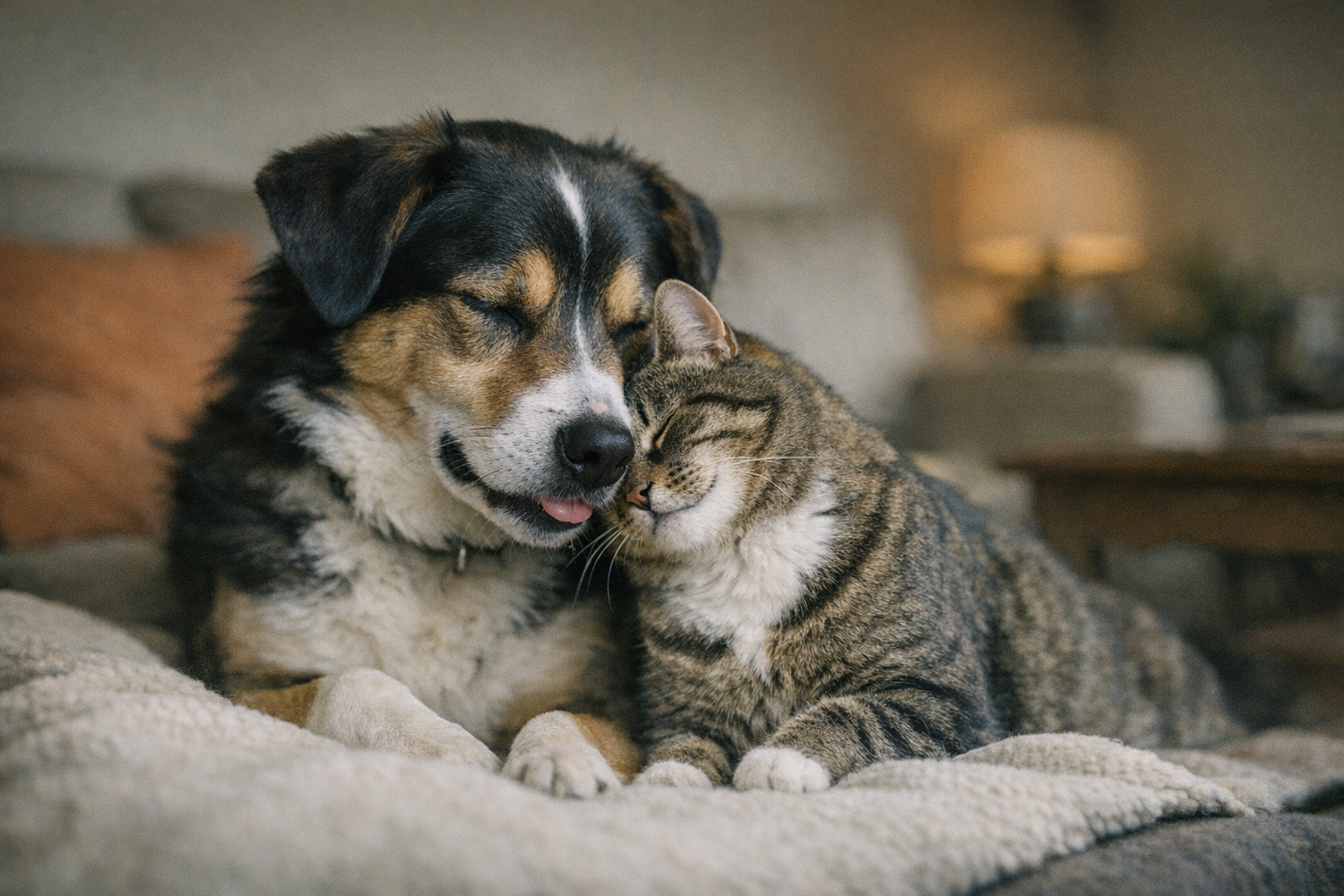

Do Dogs and Cats Know When They Are Loved?
Here is the thing about whether pets know they are loved: the question itself assumes they experience the world the way we do. They do not. But that does not mean the bond is any less real.
Dogs show distress when you leave and joy when you return. Cats choose your lap over the warm spot by the window. These are not accidents. Research shows that when dogs and their owners gaze at each other, oxytocin levels rise in both — the same hormonal response that happens between human parents and their children. That is not just behavior. That is chemistry.
The short answer is yes, pets know when they are loved, but they know it in their own language. They read your tone, your body language, the time you spend with them, and the safety you provide. Love to a dog or cat is not an abstract concept — it is the person who feeds them, plays with them, and makes them feel secure. It is you, showing up, day after day.
Love to a pet is not an abstract idea — it is the person who makes them feel safe, fed, and seen.
The science backs this up. Dogs experience a surge of oxytocin during positive interactions with their owners, similar to what humans feel. That is the biochemical foundation of the bond. Cats are more subtle, but they form attachments too — they just show it differently. If your cat slow-blinks at you or brings you a toy, that is her version of "I trust you."
This is not about projecting human emotions onto animals. It is about recognizing that the relationship you have with your pet is real, mutual, and built on behaviors that mean something to both of you. Whether you are taking photos of your dog for a custom portrait or just spending quiet time together, those moments matter. Your pet feels them.
Understanding Pet Emotions
Here is the thing about pet emotions: they do not work exactly like ours, but they are real, measurable, and tied to the bond you share. Dogs and cats do not process love the way we do — they do not write poetry or plan anniversary dinners — but the chemistry in their brains tells a clear story. When your dog looks at you, or your cat curls up in your lap, something happens inside them that looks a lot like what happens inside us when we feel close to someone.
Research shows that when dogs and humans interact, both release oxytocin — the same hormone that floods a new mother's brain when she holds her baby. This is not just a nice metaphor. It is biology. Oxytocin is involved in social bonding, and it helps buffer negative experiences. When you pet your dog, you both get a dose of it. That is the chemistry of connection, and it is mutual.
What Happens in a Pet's Brain
When dogs look at their owners, areas of the brain associated with reward and social attachment light up — the same regions that activate in human infants when they see their primary caregivers. Your dog is not just tolerating you or waiting for food. Their brain is responding to you the way a child responds to a parent. That is a bond worth hanging on your wall.
Cats are harder to read, but they have their own version of this. They do not gaze at you with the same intensity, and they do not release oxytocin in quite the same way, but they form attachments. A cat who seeks you out, who slow-blinks at you, who chooses your lap over a sunny spot — that cat has decided you are safe, and in cat terms, that is love.
The Science of the Bond
The bond between you and your pet is not one-sided. It is a feedback loop. You feel calmer when you pet them; they feel calmer when you are near. You look at them and smile; they look at you and their brain lights up. This is not anthropomorphism — it is measurable, repeatable, and consistent across studies. The bond is real, and it runs both ways.
If you are thinking about turning a favorite photo of your pet into something permanent, custom dog paintings from your photo let you capture that bond in a way that lasts. The photo you keep coming back to — the one where they are looking right at you — that is the one worth framing.
When your dog looks at you, their brain responds the way a child responds to a parent — that is a bond worth preserving.
Pets do not think about love the way we do, but they feel it in their own way. The science backs that up. The chemistry is there. The behavior follows. And the bond — the one you see in their eyes when they look at you — that is as real as anything else in your life.
Signs Your Pet Feels Loved
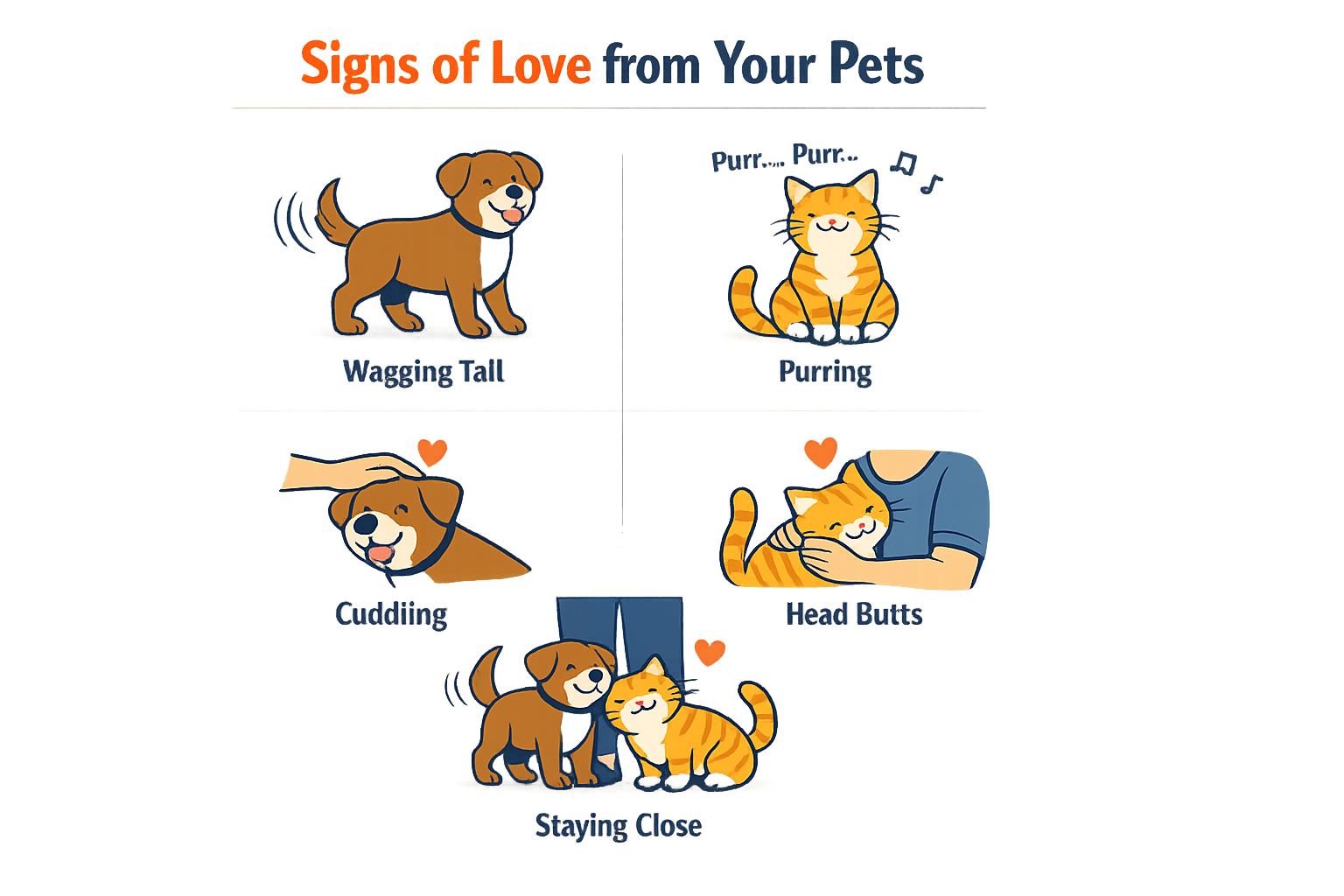
Here is the thing about reading your pet — the signs are everywhere once you know what to look for. Dogs and cats show love differently, but both speak a language you can learn. You do not need a degree in animal behavior. You just need to watch.
Your dog is the easier read. The wagging tail when you walk in, the full-body wiggle, the way she brings you her favorite toy — these are not random. She is telling you something. When your dog greets you with that explosion of joy after you have been gone twenty minutes, that is not about needing a walk. That is pure happiness that you are back.
What Dogs Do When They Feel Loved
Dogs wear their hearts on their fur. Tail wagging is the obvious one, but watch the eyebrows. When your dog sees you and those brows lift, that is recognition and affection. Eye contact matters too — a dog who holds your gaze is bonded to you. Following you from room to room, sleeping pressed against your leg, licking your hand when you are still — all of it adds up.
Bringing you toys is not always an invitation to play. Sometimes it is a gift. Your dog is sharing what she values with the person she values most.
What Cats Do When They Feel Loved
Cats are subtler, but no less clear. The slow blink is the big one — when your cat looks at you and slowly closes her eyes, she is saying she trusts you. Head butts, rubbing against your legs, kneading your lap with her paws — these are all cat versions of "I love you."
A cat who shows you her belly is not always asking for a rub (do not fall for that trap), but she is showing vulnerability. That only happens when she feels safe. Purring in your presence, following you to the bathroom, sitting on your keyboard when you are trying to work — annoying, yes, but also affection.
Capturing these moments in a photo is half the battle when you want to turn them into something you can keep. If you are thinking about creating custom cat portraits or dog paintings, the photo that shows this kind of connection is the one worth hanging.
| Behavior | Dogs | Cats |
|---|---|---|
| Greeting excitement | Tail wagging, jumping, full-body wiggle | Tail up, slow approach, head butts |
| Eye contact | Direct gaze, raised eyebrows | Slow blinks, half-closed eyes |
| Physical touch | Licking, leaning, sleeping on you | Kneading, rubbing, sitting near (not on) |
| Following you | Room to room, constant presence | Selective — bathroom, kitchen, quiet moments |
The Little Details That Sell It
You will know it when you see it. The way your dog's whole face changes when you say her name. The way your cat purrs before you even touch her, just because you are in the room. These are not trained behaviors. You cannot teach a pet to love you. They either do or they do not, and when they do, it shows in a hundred small ways every single day.
The photo everyone gets wrong is the posed one — stiff, formal, looking at the camera. The shot that actually works is the one where your pet is looking at you, mid-wag or mid-purr, doing the thing that makes you smile every time. That is the portrait worth framing.
The Bond Between Pets and Owners
The relationship between you and your pet is not one-sided. Dogs depend on us for their survival, just as humans benefit from their presence — it is a genuine partnership built on mutual need and affection. That back-and-forth is what makes the bond feel so real, because it is.
How Love Shapes Your Pet's Behavior
When your dog knows they are loved, you see it in how they move through the world. A dog who feels secure is calmer, more confident, and less reactive to stress. They trust you to handle the hard stuff, so they can relax. That is not obedience training — that is emotional safety.
Cats show it differently. A loved cat is more likely to engage with you on their terms, seeking you out for contact rather than hiding. They become bolder, more playful, and more willing to be vulnerable. Love does not make a cat clingy; it makes them present.
The Emotional Benefits for You
Here is the thing: the bond goes both ways, and the benefits are measurable. A 2025 study involving 717 dog owners found that dogs scored remarkably highly for companionship and emotional support, often exceeding the ratings given to many human relationships. That is not sentimental — that is data.
Strong bonds are associated with more positive emotions, less loneliness, and a greater sense of purpose. Your dog is not just receiving your love; they are actively contributing to your emotional well-being. The portrait you hang is not just a picture of them — it is a reminder of what they give you every day.
Dogs provide companionship and emotional support that often exceeds the ratings given to many human relationships.
Why the Bond Feels So Deep
The connection you feel with your pet is not imagined. It is built on thousands of small interactions — the way they greet you, the way they settle next to you, the way they watch your face for cues. Over time, those moments compound into something that feels irreplaceable, because it is.
That is why pet memorial portraits resonate so strongly. They capture the essence of a bond that shaped your daily life, and they keep that presence in the room even after your pet is gone.
Memorializing Your Pet's Love
Here is the thing about losing a pet: the love does not stop. It sits there, looking for somewhere to go. A memorial gives it a place to land — something you can see, touch, and keep in the room with you.
The photo you keep coming back to is usually the one. Not the posed shot from the groomer, not the holiday card. The one where they look like themselves — ears back, mid-yawn, caught in good light at their eye level. That is the photo worth framing, and it is the one that makes a portrait feel like them.
Why Memorials Matter
A memorial is not about forgetting or moving on. It is about keeping them in the room. When you turn a favorite photo into a painted portrait, you are not trying to replace them — you are giving yourself permission to remember them the way they actually were. Soft, warm, and a little dramatic.
The era you choose matters. A Renaissance-style portrait feels timeless and dignified. A watercolor keeps things gentle. Royal portraits work when your pet had that kind of presence — the ones who owned the couch and knew it. Let the photo breathe. The little details that sell it are already there: the tilt of their head, the way their eyes caught the light, the collar you can still picture in your hand.
You do not need a studio photo. You need the shot that actually works — the one that makes you stop scrolling. Trust me on this: if it feels like them on your phone, it will feel like them on your wall.
Choosing the Right Memorial Portrait
The photo everyone gets wrong is the one where the pet is too far away or the background is doing all the talking. For a memorial, you want their face, their eyes, and enough headroom that the portrait does not feel cramped. Cropping matters. Framing matters. The portrait should feel like you could reach out and scratch behind their ears.
If you are considering a memorial portrait, start with the photo that makes you feel something. Not the technically perfect one — the one you keep coming back to. That is the part people skip, and it is the whole game.
Pet memorial portraits let you hold onto the way they looked at you, the way they filled a room, the way they made you feel seen. It does not have to be perfect. It just has to be them.
A portrait worth framing is not about the pose — it is about the moment you cannot let go of.
The Emotional Impact
Memorials do something quiet but real: they let grief settle without disappearing. You are not trying to get over it. You are learning to live with it in a way that does not hurt every single time. A portrait on the wall becomes part of the room, part of the routine. You walk past it. You glance at it. You remember without having to try.
That is what makes it worth hanging. Not because it is art — though it is — but because it keeps them close in a way that feels right. The bond does not end. The love does not stop. You just give it somewhere to go.
Conclusion: The Lasting Impact of Love
Here is the thing about loving a pet: they know. Not the way we know things — not with words or logic or a mental checklist — but in the way that matters most. They know it in the soft place they choose to sleep, in the way they watch the door when you leave, in the thousand small moments that add up to a life lived together. You do not need a study to tell you that. You already see it.
The bond you share with your pet is not one-sided. It is built in both directions — your care, their trust, your routine, their response. They feel safe because you made them safe. They come to you because you have always been there. That is love, even if it does not look like the love we give each other. It is just as real, and just as lasting.
When the time comes to say goodbye — and it always comes too soon — that love does not disappear. It lives in the photos you kept, the collar that still smells like them, the spot on the couch that will always be theirs. A pet memorial portrait is one way to keep them in the room, to let that love stay visible instead of fading into memory alone. It does not have to be elaborate. It just has to feel like them.
The love you gave them shaped their whole world — and the love they gave you shaped a piece of yours.
Trust me on this: the time you spend with them now matters. The photos you take, the moments you notice, the way you show up every single day — that is the stuff that builds a bond worth remembering. They do not need grand gestures. They just need you, steady and present, the way you have always been.
So keep taking the photos. Keep noticing the little things — the way they tilt their head, the spot where the light hits them just right, the expression that is unmistakably theirs. Those details are not just for you. They are the proof that you saw them, that you loved them, that they mattered. And when you look back, you will know: they felt it too.
Discover if pets know they are loved and how they express emotions. Learn the signs of love from dogs and cats in this insightful article.